
Risk stacking on the road.
New research from the TAC’s Road Safety Monitor has found that when Victorian drivers take a risk on the road, it’s rarely just one. Surveying more than 2,000 Victorian licence holders, the TAC identified a pattern researchers are calling “risk stacking” – combining two or more dangerous behaviours in the same trip.
What the numbers show
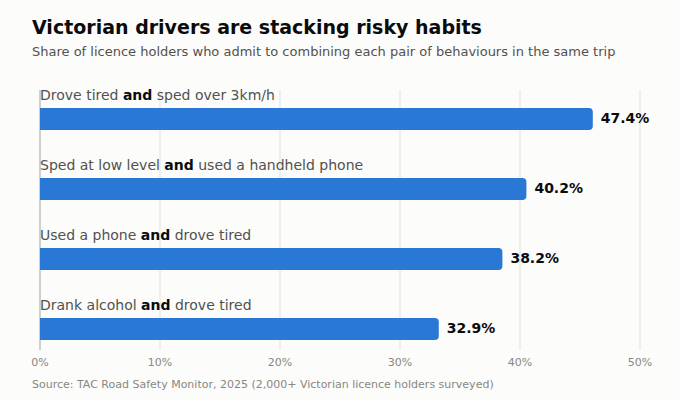
Almost half of respondents (47.4%) admitted to both driving tired and speeding by more than 3km/h. Around 40% said they’d combined low-level speeding with handheld phone use, and 38.2% had used a phone while also driving fatigued. Just under a third (32.9%) had driven after drinking alcohol and while tired.
Why combining risks is so dangerous
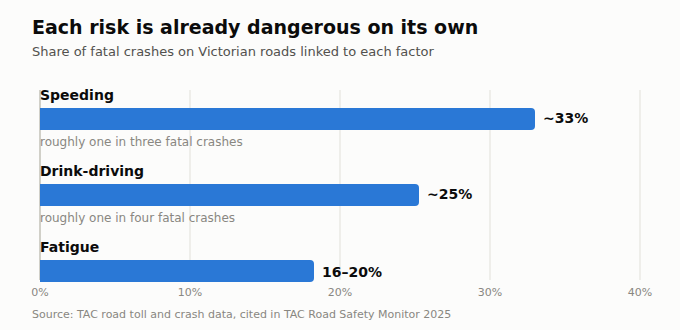
Each of these behaviours is already a well-established contributor to fatal crashes on its own. Speeding features in roughly a third of fatal crashes in Victoria. Drink-driving contributes to around a quarter of road deaths. Fatigue plays a role in 16–20% of fatal crashes.
TAC CEO Tracey Slatter noted that dangerous driving behaviour puts lives at risk on its own – and that combining risky habits doesn’t just add to the danger, it multiplies it. A driver who is tired and speeding, or distracted and pushing the limit, is dealing with a compounding set of risks rather than a single lapse in judgement.
What’s changing
The TAC will launch its Crossroads enforcement campaign next month, targeting drink-driving and speeding specifically. It builds on recent awareness efforts around fatigued driving and low-level speeding, reflecting a broader push toward addressing these overlapping behaviours together rather than treating each as an isolated issue.
Road trauma affects far more than the person behind the wheel. Victoria’s TAC scheme operates on a no-fault basis, meaning support is available to those injured in transport accidents regardless of how the crash happened.
Recent Comments